A form has been sent home to help me get to know your child. Please return the completed form as soon as possible. I am very eager to learn what you have to share. If you need another copy, a link is provided below. If you contact me I will also be able to print another out for you. I plan to use this form during our first parent conference to aid our discussion about your child's academic progress.
Thank you.
Getting to Know You
Sunday, August 18, 2013

Saturday, August 17, 2013
Classroom Setup
August 19, 2013
Dear Parents/Guardians:
The classroom setup reflects the needs of the students and
the teacher. It is designed to enhance
all learning activities. The student
desk and table arrangement allows the teacher and students to move about the
room freely. The attached diagram shows
an approximation of our classroom. In
the diagram numerals have been added to show how the design will allow center
and whole-class instruction to take place.
The placement of furniture, materials, and storage have been carefully
considered while planning the diagram.

This diagram has been created using the tool available at Scholastic.com:
The desks and table were placed to facilitate center
work. Students will rotate through
centers one, two, three, and four on one day.
Those outlying centers will rotate counter-clockwise at fifteen to
twenty minute intervals. Students will
rotate through centers five, six, seven, and eight for leveled reading on
another day. Center eight is where the
teacher will provide guided reading practice and tutoring. Those centers will
also run counter-clockwise. A pocket chart keeps track of the
rotations. If students are pulled out
for other instruction or are out of the room at transitions, they may refer to
the chart to find where they should be.
At the beginning of the year rotations may need to be as
short as ten minutes. By the end of the
year twenty-five minutes may be appropriate.
The first one or two weeks of school will be spent familiarizing
students with the format of activities they will be expected to complete during
center time. The center rotations will
also be practiced.
Several areas have specific functions. The table placed by the door (at number
three) next to the sink is where students will complete craft and paint
projects. The table is located over an
area with flooring which can easily be cleaned in case of spills. Area number two is located on the flooring
by a bookshelf where tubs of books are for students to select from. This area will also be used as a listening
center as well as for other reading activities. At area eight, the teacher maintains student
folders in the bookshelves for small group reading instruction. Students will have access to their reading
folders containing Houghton Mifflin reading materials. Area four in the diagram is set up for
computers at the back of the room. This
area may be used during center time or independent work time. Being set up at the back of the room helps
keep it from being a distraction to students not in the area.
Students have pencil boxes on their desks marked with their
student number and
name. Inside the
boxes there are crayons, two pencils, scissors, a glue stick, and an
eraser all marked with their student number. Students take these boxes to their
centers.
However, extra crayons or glue may be set out at the center
to avoid any shortages.
Other materials are set out at centers as needed. Students will always have access to what they
need. Students are held responsible for
lost materials.
Students will sit at their seats for whole-class
instruction. In making desk assignments
I consider student needs for space, vision, and their ability to work
independently.
In their desks are materials such as workbooks, textbooks
and other necessary reference and study materials.
The floor area at the front of the room is used to
facilitate activities such as making a KWL (what I know, want to know, and
learned) chart and reading from big books which everyone can. This area also works nicely for
group discussions or class meetings. This area is
marked off with tape to help students find their spot.
A great deal of time went into the design of the
classroom. If you have any questions or
concerns please feel free to contact me.
I hope you will feel confident that your student’s educational needs are
represented in my classroom.
Behavior Intervention
During class intervention may be necessary when other
strategies have not worked to redirect student behavior. Usually moving closer to the student, making
eye contact, reminding them of the rules and procedures, or working toward
student participation and engagement in academic activities is all that is
needed. However, when those strategies
do not work the following will be implemented:
1. Warning.
2. Student takes a time out
to reflect on their behavior, its cause, and how to correct it.
3. A plan is written with
the aid of the teacher during recess on how to correct the behavior
and meet their
needs in an alternative manner. Note
home.
4. 10-15 minute lunch
detention and phone call home.
5. Referral to Student
Advocate
Please see the sample forms in the following links for
steps two, three, and four. Also,
please note that an act of disrespect or defiance will result in immediate
assignment to detention. An act which violates the safety of another
student will also result in immediate detention.
Parent Permission to Blog Student Work
Dear Parents:
This permission slip will be sent on the first day of school. A link to it is provided for your convenience. If you need another hard copy of it, I would be happy to get one to you. Just let me know. Your permission to use your student's work would be greatly appreciated to help us communicate with one another through this blog. Only select the option you are comfortable with.
Parent Permission to Blog Student Work
This permission slip will be sent on the first day of school. A link to it is provided for your convenience. If you need another hard copy of it, I would be happy to get one to you. Just let me know. Your permission to use your student's work would be greatly appreciated to help us communicate with one another through this blog. Only select the option you are comfortable with.
Parent Permission to Blog Student Work
Rules and Procedures
2013-2014 School Year
Hello and Welcome to the new school year! I hope to get to know you and your child very well during this time and look forward to all the learning that is going to occur. First grade is an incredible year of academic growth. It is exciting to be a part of.
In this post you will find a link to the rules and procedures. I will be working hard with the students to establish these in the classroom in order to ensure a productive and safe learning environment. In the next post, please find the related behavior intervention plan I will implement. Working together with parents is highly valued. If you have any suggestions or question please call the school after 2:30 PM or send me an email.
If the link below does not work, please, contact me and I will get you another copy.
Hello and Welcome to the new school year! I hope to get to know you and your child very well during this time and look forward to all the learning that is going to occur. First grade is an incredible year of academic growth. It is exciting to be a part of.
In this post you will find a link to the rules and procedures. I will be working hard with the students to establish these in the classroom in order to ensure a productive and safe learning environment. In the next post, please find the related behavior intervention plan I will implement. Working together with parents is highly valued. If you have any suggestions or question please call the school after 2:30 PM or send me an email.
If the link below does not work, please, contact me and I will get you another copy.
Friday, October 5, 2012
Addition, Retelling, Creating
We have been covering addition and will move to subtraction next week. Keep your students counting forward and backward to help them with these concepts. The skill we, the first grade teachers at our school, like to focus on is counting on. We are also starting to work on memorizing math facts and beginning timed addition tests. Be on the lookout for these tests coming home to see how your child is doing. We will start out slowly, and then move on to more facts as the students become more proficient at addition and subtraction concepts.




Click here to find the original book:
http://www.betterworldbooks.com/9781563978456-id-9781563978456.aspx
A simple activity like this gets the children excited over their reading. They begin to own it. I loved seeing their smiles as we read through their pages. Not only did they review vocabulary for classroom items but they also studied a simple story structure.
Note: All of these activities did not supplant the curriculum. They supplemented it.
Here is a little activity we did to create a math problem and solve it using addition:


For reading, we used the story of The Little Red Hen to review and practice sequencing, retelling, and summarizing. First we looked at pictures, discussed what was happening, and agreed what order they should go in:

Next, we came up with a simple summary of the story:

Then, we came up with a play for the story, a format which tied in nicely with the play we read in our anthology, The Rope Tug:

Finally, we drew some scenery and made finger puppets to retell the story. The kids noticed that the book characters and the puppets were different. I explained that there are different variations of this story using different animals. When we do a more in depth study of the setting of a story I am planning to create our own story patterned after The Little Red Hen set in the jungle or any habitat they are interested in. I wonder what animals the children will choose.

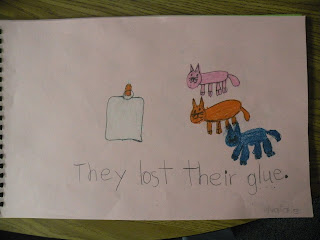
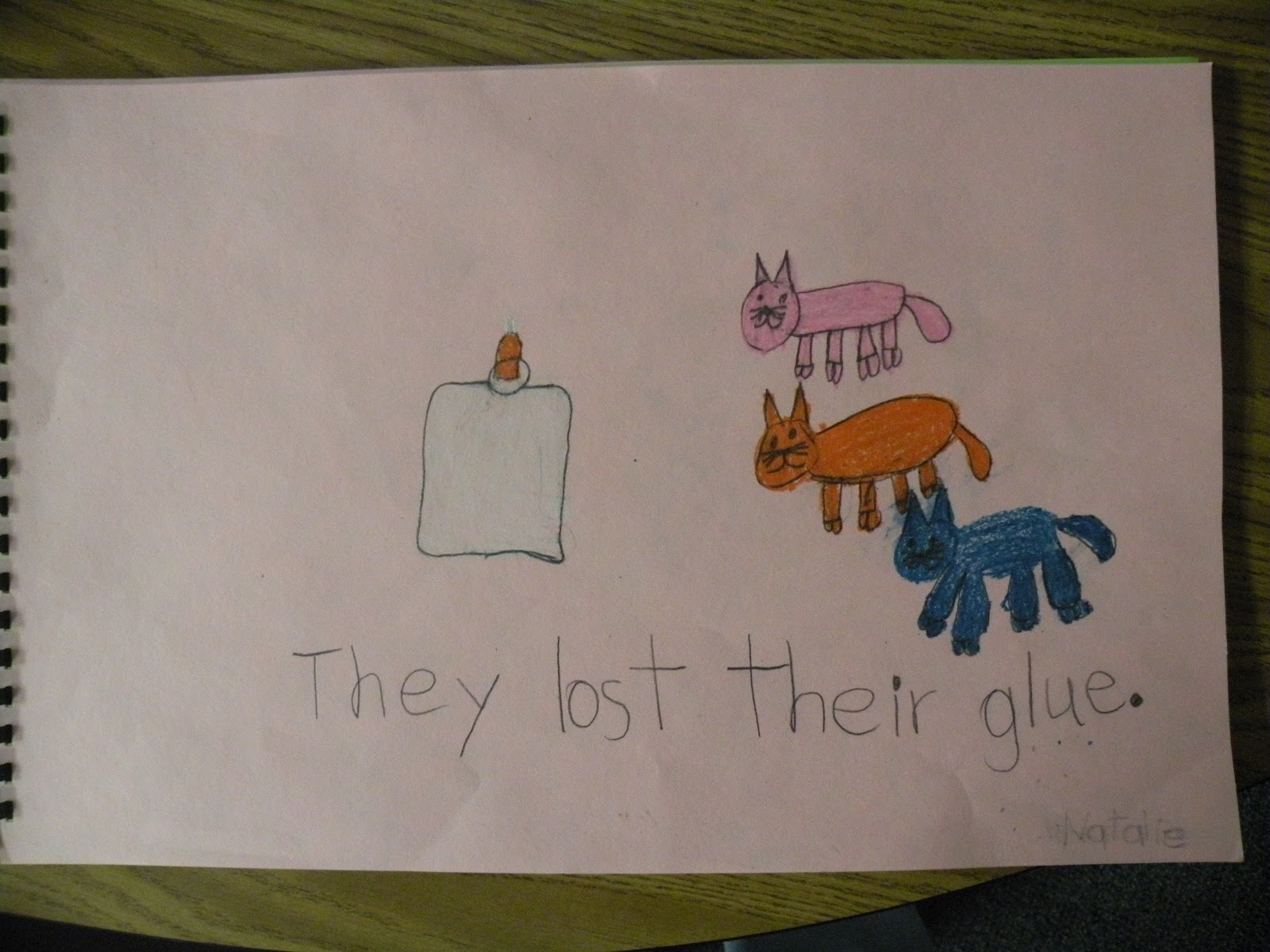
We recently completed a class story using a simple sentence frame and some cards that have labeled pictures of items in the classroom. After reading The Three Little Kittens by Lorianne Siomades
the students made this:




Click here to find the original book:
http://www.betterworldbooks.com/9781563978456-id-9781563978456.aspx
A simple activity like this gets the children excited over their reading. They begin to own it. I loved seeing their smiles as we read through their pages. Not only did they review vocabulary for classroom items but they also studied a simple story structure.
Note: All of these activities did not supplant the curriculum. They supplemented it.
Favorites in the Classroom
Last week's parent conferences were great. I very much enjoyed meeting with this class of parents, and I am excited about working together toward every student's success.
During that week I was given a chance to do some review and change up the pace a bit. I read a few more of my favorite books. One of the students pointed out that I have more than one favorite. That is true. I get excited about many of the stories I am able to share in class and only wish I had more time to do so. Here are a couple of books that the students enjoyed as much as I did:
Harry and The Lady Next Door by Gene Zion:
http://www.betterworldbooks.com/9780064440080-id-9780064440080.aspx
and
Olivia and the Missing Toy by Ian Falconer:
http://www.betterworldbooks.com/9780689852916-id-9780689852916.aspx
Both of these stories kept the students listening to hear what was going to happen next. There was just the right balance between keeping the reader questioning, guessing, and laughing. They are perfection between two pieces of pressed cardboard. The illustrations and excellent writing are an unbeatable combination. Just ask your child.
Parents, in your booklet from Back to School Night is a list of questioning strategies that would work very nicely with these stories. I hope you get a chance to read them.
During that week I was given a chance to do some review and change up the pace a bit. I read a few more of my favorite books. One of the students pointed out that I have more than one favorite. That is true. I get excited about many of the stories I am able to share in class and only wish I had more time to do so. Here are a couple of books that the students enjoyed as much as I did:
Harry and The Lady Next Door by Gene Zion:
http://www.betterworldbooks.com/9780064440080-id-9780064440080.aspx
and
Olivia and the Missing Toy by Ian Falconer:
http://www.betterworldbooks.com/9780689852916-id-9780689852916.aspx
Both of these stories kept the students listening to hear what was going to happen next. There was just the right balance between keeping the reader questioning, guessing, and laughing. They are perfection between two pieces of pressed cardboard. The illustrations and excellent writing are an unbeatable combination. Just ask your child.
Parents, in your booklet from Back to School Night is a list of questioning strategies that would work very nicely with these stories. I hope you get a chance to read them.
Subscribe to:
Posts (Atom)